Within days of taking the two shots, Francis' feet began to tingle and burn. When he later took the second in a series of six anthrax shots, his health slid downhill. Since then, the 45-year-old messmate from Las Vegas has fought a rare nervous system disease known as Guillain-Barre Syndrome, along with chronic pain, pneumonia and a life-threatening blood clot.
Showing posts with label anthrax. Show all posts
Showing posts with label anthrax. Show all posts
Tuesday, April 28, 2009
Mandatory anthrax vaccinations raise concerns


Monday, April 27, 2009
A New Bio Warfare Arms Race Begins in Maryland
Fort Detrick actually began in 1943 as Camp Detrick and worked with the British in creating an anthrax bomb. It became a permanent Army installation, Fort Detrick, in 1956 and developed offensive bio-weapons. But, in 1969 during the Vietnam War, when the U.S. was criticized for using gas, napalm and herbicides in Vietnam, President Nixon unilaterally ended the nation’s offensive biological warfare program and ordered pathogens and toxins destroyed. This also led to the signing of the Biological Weapons and Toxins Convention in 1972 which became law in 1975. It was discovered in 1975 that the CIA had disobeyed the order to destroy all bio-weapons stocks, and had retained pathogens and toxins for its own use. In the 1980’s, the Reagan and Bush Administrations revived the dormant budget for "defensive" biowarfare research. It was also in the 1980’s that the U.S. supplied Saddam Hussein with the basis for Iraq’s biowarfare capability.
Tuesday, March 3, 2009
Sandia National Laboratories Test Exonerates Ivins
While government apologists are still trying to pretend there is a case that Bruce Ivins was the anthrax killer, tests by Sandia National Laboratories have exonerated him.
As the publisher of the prestigious scientific journal Nature writes:
At a biodefence meeting on 24 February, Joseph Michael, a materials scientist at Sandia National Laboratories in Albuquerque, New Mexico, presented analyses of three letters sent to the New York Post and to the offices of Senators Tom Daschle and Patrick Leahy. Spores from two of those show a distinct chemical signature that includes silicon, oxygen, iron, and tin; the third letter had silicon, oxygen, iron and possibly also tin, says Michael. Bacteria from Ivins' RMR-1029 flask did not contain any of those four elements.
Two cultures of the same anthrax strain grown using similar processes — one from Ivins' lab, the other from a US Army facility in Utah — showed the silicon-oxygen signature but did not contain tin or iron. Michael presented the analyses at the American Society for Microbiology's Biodefense and Emerging Diseases Research Meeting in Baltimore, Maryland.
At a biodefence meeting on 24 February, Joseph Michael, a materials scientist at Sandia National Laboratories in Albuquerque, New Mexico, presented analyses of three letters sent to the New York Post and to the offices of Senators Tom Daschle and Patrick Leahy. Spores from two of those show a distinct chemical signature that includes silicon, oxygen, iron, and tin; the third letter had silicon, oxygen, iron and possibly also tin, says Michael. Bacteria from Ivins' RMR-1029 flask did not contain any of those four elements.
Two cultures of the same anthrax strain grown using similar processes — one from Ivins' lab, the other from a US Army facility in Utah — showed the silicon-oxygen signature but did not contain tin or iron. Michael presented the analyses at the American Society for Microbiology's Biodefense and Emerging Diseases Research Meeting in Baltimore, Maryland.
It had previously been known that the killer anthrax contained silicon - an agent for weaponizing anthrax. But I have never previously read that the killer samples also contained iron and tin.
As the world's top anthrax experts have pointed out, Ivins did not possess either the know-how or the equipment to weaponize the anthrax. See this and this.
As the world's top anthrax experts have pointed out, Ivins did not possess either the know-how or the equipment to weaponize the anthrax. See this and this.
Monday, September 8, 2008
Early anthrax suspect doubts guilt of Ivins
 Full Story - Frederick News Post
Assaad, who worked in a U.S. Army Medical Research Institute of Infectious Disease lab at Fort Detrick from 1989 to 1997 developing a vaccine for ricin, said in an interview Saturday he does not believe Ivins was guilty.
"He's a great man. He's honorable, sincere, honest and most important, he didn't kill five people and he didn't kill himself," Assaad said.
"I know what Bruce went through, because I went through it too," he said.
Wednesday, August 20, 2008
The Anthrax Files
The FBI claims to have caught the killer. But so much evidence has been neglected or mishandled that many experts still have doubts.
The first week of August, the popular press got back in the game, reporting the apparent suicide of USAMRIID scientist Bruce E. Ivins, alleged to be the sole operator behind the anthrax letters. The Associated Press reported that Ivins, who is said to have killed himself on July 29 with an overdose of prescription Tylenol mixed with codeine, was “one of the government’s leading scientists researching vaccines and cures for anthrax exposure.” According to the AP, he was “brilliant but troubled.” His lawyer, Paul Kemp, says that Ivins passed a pair of polygraph tests and that the grand jury investigating the case was weeks from returning an indictment. Yet within days of his death, the bureau announced that it was beginning the shutdown of its “Amerithrax” investigation. “Anthrax Case a Wrap,” blared the Daily News on Aug. 4.
In April, it was reported that the FBI had been focusing on as many as four suspects. Fox News identified them as a “former deputy commander,” presumably in the U.S. Army, a “leading anthrax scientist,” and “a microbiologist.” The fourth suspect was given no description. Now the bureau is “confident that Dr. Ivins was the only person responsible for these attacks,” according to the assurances of the U.S. Attorney for the District of Columbia.
Monday, August 11, 2008
Sander Hicks: The “Mad Scientist” Ivins, and Other 9/11 Legends
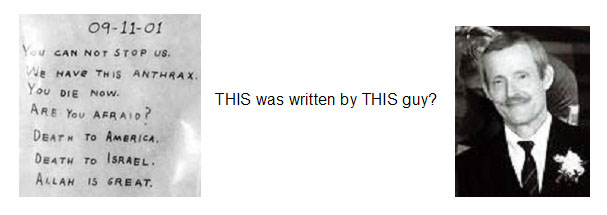
The note sent to Tom Daschle and the late Dr. Bruce Ivins
By Sander Hicks
9/11 Blogger - 8.8.08
9/11 Blogger - 8.8.08
As the sun begins to set on the tyrannical Bush/Cheney Administration, a “culprit” for the anthrax attacks has been dropped on us. The government has produced the dead body of “mad scientist” Bruce Ivins, the way a smiling cat produces a mouse carcass. This new lone assassin story holds together quite well: as long as you look only at it, and not at any of the other grisly details about US government involvement in anthrax.
The biggest hole in the current news story is that we all are expected now to reverse seven years of thinking, and suddenly believe that the anthrax attacks had no connection to 9/11. They were the work of an American insider, a psycho killer inside the US Army’s Fort Detrick, the Maryland headquarters of tax-payer funded chemical warfare.
With all the blame on Ivins, the official story has contradicted itself.
Above is the letter that was sent to Senator Tom Daschle. Would a crazy mad scientist NOT tied to the 9/11 attacks send his anthrax letters out right after 9/11, with “09-11-01” on top, and end the cover note with “Allah is Great”? Would he be willing to contribute to the public terror and build up the effect of 9/11, resulting in the advancement of the neo-con agenda? And here’s the stickler: Would he drive seven hours to Princeton, NJ to mail the letters, because he’s obsessed with a Catholic sorority there, but at the SAME time he’s sane enough to use the 9/11 attacks as a cover story? One that keeps him safe for seven years?
Something doesn’t add up.
Remember Jerome Hauer? We New Yorkers remember him well as the guy whose idea it was to spray carcinogenic insecticides, at eye level, from small pick up trucks, in residential city neighborhoods, to combat the almost nonexistent threat of “West Nile Virus” back in the Giuliani days. He was a NYC Government bio-terrorism expert who happened to be doing a bio-terrorism drill called “Tripod II” inside the World Trade Center on the morning of 9/11. It turns out Hauer is old friends with Steven Hatfill, the other anthrax suspect. It turns out, they both lectured at the Council on Foreign Relations together not too many years ago on the topic of “Building a ‘BioBomb’: Terrorist Challenge.” Yep, Hatfill, who commissioned a report from the CIA on how to attack people using anthrax in the mail, back when he worked at Ft. Detrick.
According to a San Jose newspaper, Jerome Hauer told the White House to go on Cipro on the evening of 9/11/01. They did. (On the phone with me, he denied telling the White House that, for what it’s worth.)
Shortly thereafter, Hauer’s next job was at the National Institute of Health, where he was tasked with, guess what? Investigating the anthrax attacks. And who did he point the finger to? Not Ivins, not Hatfill, not any of the gang at Ft. Detrick, or S.A.I.C., Hatfill and Hauer’s old employer, the military contractor. No, Hauer blamed Al Qaeda and Bin Laden. Another Democrat reading from the neo-con hymnal.
(In the same way, when Dan Rather looked at the collapse of the towers on 9/11 and on live TV said it looked just like one of those controlled demolitions, Hauer happened to be right there alongside Rather, saying, nope, it’s clear to me right now that it was jet fuel that dropped those structures. He knew more than one page of the hymnal.)
When you hear the media go on and on about Bruce Ivins’ obsession with sorority girls, or his insanity, take it with a grain of salt. A man’s reputation is fragile and it’s the first thing attacked in a situation like this.
For example, take Dr. Graham. He was a 9/11 truth researcher who died two years ago in Louisiana. Dr. Graham was a Louisiana community activist, a Vietnam veteran, an evangelical, an inventor, and a dentist who met two of the 9/11 hijackers in his hometown of Shreveport ten months before 9/11. He warned the FBI that he found the two young Saudis suspicious. But he was verbally abused and threatened by FBI. When 9/11 happened, these same two young Saudis were called Bin Laden’s right hand men. That’s interesting because the same two were protected by various agencies of the Federal government in multiple instances, in various cities across the USA.
In 2004, on the verge of publishing a book about his experiences with the FBI and the 9/11 terrorists, Dr. Graham was poisoned.
Here’s where the Graham story becomes a lot like the Ivins story. Graham was taken to the hospital and the FBI showed up in the ER at the same time. The FBI intimidated doctors, told them he was crazy. The cardiac surgeon abandoned Graham after that. The FBI implied Graham was suicidal to the Shreveport media. Graham died a slow death a year and a half later from the poisoning. The local media there have been reticent to cover this story, and effectively consented to let the FBI write it for them. But it’s the FBI who should be indicted for murder.
Recently, anthrax suspect Steven Hatfill was paid $6 million of your taxpayer dollars. He didn’t like being called a “person of interest” in the anthrax investigation and he sued the Department of Justice. Wow, $6 million. I guess it pays to be friends with people like Jerome Hauer and the Council on Foreign Relations. And yet I’m still waiting for answers regarding so much about Hatfill. I wish I had all the time in the world to fully research his alleged ties to far-right fascist groups in South Africa (who used anthrax). And why did the Washington Post Magazine report that a glove box for handling toxic chemicals was found concealed at the bottom of a pond on Hatfill’s property? The $6 million doesn’t exonerate him in my eyes. It sounds like someone pulling favors.
The same Department of Justice that paid him hasn’t responded to my formal request that the Inspector General at Justice look into FBI involvement in the death of Dr. Graham. This might seem unreasonable but they themselves promised a response. They are now five months late. I had called them from Shreveport after I had confronted the local FBI. I felt the walls closing in. The FBI didn’t deny that they had told the local media the Graham was crazy. They stuck to their story and tried to get me to believe it. But they couldn’t provide evidence. There is none. Graham was a good man and his suspicions were right on. The FBI agent I talked to had murder and cover-up just pouring out of his body-language, his nervous twitches, and the way he expelled me and another reporter from their offices.
In the same way, we are being handed an official story about Bruce Ivins. But details are left out. Like why did the FBI have to offer Ivin’s son $2.5 million and the “sportscar of your choice” to say certain things about his dad? If Ivins was guilty, then why the need to fabricate evidence? An offer of $2.5 million sounds heavy handed, like you’re desperate to find a fall guy, dead or alive. Preferably dead, patsies are so much more agreeable that way.
Let’s go back to Jerry Hauer. This was a guy who came up a lot at the Citizens Grand Jury convened by citizen activists in the well-organized 9/11 truth community. When I was researching my story on the Spitzer-Silverstein connection for New York Megaphone, I tracked down Hauer’s home phone number and called him on Labor Day, last fall. My timing was good, because I think he was a little drunk. He said things slightly slurred, and was at times a bit too honest. It was all a joke to him. On the audio file you can hear people laughing in the background.
We discussed the San Diego Citizens Grand Jury Indictment, which he dismissed with insults, but couldn’t say why.
He confirmed that he worked with Hatfill at SAIC. Then, I asked if Hatfill was innocent of involvement in the anthrax attacks. He was less than direct:
HICKS: A lot of people are wondering you know, where these anthrax attacks came from.
HAUER: I have uh…NO idea.
HICKS: Do you think that Hatfill is innocent?
HAUER: I…I…think that the FBI…should not have s…said anything about Hatfield until they knew more. I do not think Steve Hatfield is a murderer. I think Steve Hatfield is very passionate but I don’t think he’s a murderer. I don’t believe he did it.
HICKS: Uhhhh. That seems to be not the most clear, specific response in the world. I’m wondering if you’re saying that Hatfill…Can you say conclusively that Hatfill was not involved in the anthrax attacks? Is that what you’re saying?
HAUER: I’m not going to get into those details.
HICKS: So you’re leaving some room for ambiguity?
HAUER: No, I’m not. I’m not going to get into those details.
HICKS: Why not?
HAUER: I just don’t want to comment on it.
I just listened to the whole mp3 again for the first time in a while. I remember the night I made the interview. And then, using 1/8 inch audio cables, I turned my phone recording tape player into something that could talk to a Mac. Using some mp3-studio shareware I downloaded, I made this mp3. I was excited because I sort of knew that someday, the US Government and the FBI would throw up a sloppy non-answer for the anthrax attacks. And on that day, I knew that this interview would be especially relevant. I felt at the time I had contributed something to advancing the real story on anthrax.
In this audio file, notice how Jerry Hauer sort of acknowledges that the FBI is mishandling the case, and yet he still refers he to them as the place to go for answers. That’s called misprision of a felony, when you know that someone is committing a crime, like covering up the five anthrax murders. But you don’t do anything about it.
Maybe because you were involved.
Audio - Hicks and Hauer:
Thursday, August 7, 2008
‘Suicide’ of Anthrax Scientist–Another Mossad Frame Up?
But more importantly, as any good cop will testify, a case not closed means a case still open, which means going back to square one and reviewing the evidence all over again in the hopes of finding something possibly missed. Obviously this means looking at information certain entities (and particularly those interested in dragging the US into Israel’s dirty wars) can’t afford to have exposed to public scrutiny, and in particular the evidence revolving around a certain Lt. Col. Phillip Zack.
For those who bought into the made-in-Israel storyline following the 2001 anthrax attacks that ‘the Ay-rabs did it,’ Zack was a researcher at the same Ft. Dietrich bio-weapons lab where the now ‘suicided’ Bruce Ivins worked. Along with Zack and Ivins was also one Ayyaad Assaad, an Egyptian-born scientist who became the butt of a concerted anti-Arab, anti-Islamic campaign organized and executed by Zack and some of his cohorts at the lab who collectively called themselves ‘the Camel Club’. A few days after 9/11 an anonymous letter turned up at a Marine base in Quantico Virginia accusing Assaad of being a terrorist planning biological attacks against America. According to Assaad’s testimony to the FBI agents who interviewed him, the personal information contained in the letter could only have been written by a co-worker at the lab, and surprise, surprise, a few days later, anthrax turns up in the mail. Furthermore, a security film caught Zack entering the Ft. Dietrich facility after hours at a time he no longer worked there, and more importantly, caught him on tape entering a secure section of the facility where the very same strain of anthrax used in the attacks later turned up missing. Given that the anthrax attacks amounted to the use of a weapon of mass destruction against the United States, naturally investigative eyes were on all persons considered relevant to the case, and–almost as if on cue–just about the time Zack and his anti-Arab bigotry started to circulate as clues in the case, the previously-mentioned Barbara Hatch Rosenberg floated the idea that Steven Hatfill should be put under the microscope, which he was, while all investigation of Zack slipped out the proverbial back door, never to be mentioned again.
Anthrax victim doesn't believe Gov't Story
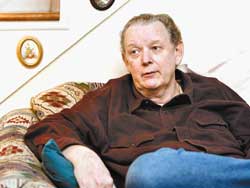
Since inhaling anthrax at a Sterling postal facility in 2001 and filing a lawsuit against the federal government, he says he’s been wiretapped, followed, and threatened by government officials.
That’s why Hose, 66, has sympathy instead of anger for Bruce Ivins, the scientist who worked at the Army’s biological warfare defense labs. Ivins committed suicide last week as prosecutors prepared to charge him with carrying out the anthrax attacks seven years ago.
“I don’t care for anybody that does the kind of work he did, but they’re using him as a scapegoat,” Hose said. “They’ve harassed that man for 41/2 years and he finally broke.”
Ivins had 'no access' to powder Anthrax at Ft. Detrick
A BRAD BLOG reader points us to this curious note, near the end of a late-afternoon story from today's Washington Post coverage, noting that Ivins had "no access to dry, powdered anthrax" at the Fort Detrick lab where he worked [emphasis ours]:
Several scientists who worked with Ivins also question whether he would have had the technical skills to create the sophisticated powder used in the anthrax attack. Creating the kind of highly lethal, easily dispersible powder used in the 2001 attacks requires unique skills not normally associated with vaccine specialists.
"He had no access to dry, powdered anthrax, according to Fort Detrick spokespersons, who said that only liquid anthrax was used at the Fort Detrick facility in animal aerosolization experiments," said Meryl Nass, a physician and bioterrorism expert. "If he had been making dry anthrax, it would have been detectable."
"He had no access to dry, powdered anthrax, according to Fort Detrick spokespersons, who said that only liquid anthrax was used at the Fort Detrick facility in animal aerosolization experiments," said Meryl Nass, a physician and bioterrorism expert. "If he had been making dry anthrax, it would have been detectable."
Bruce Ivins: Patsy?
However, as we sift through the reams of media coverage occasioned by this startling development in a 7-year-old case, we get quite a different story from the alleged objects of his rage: his colleagues on the job at Ft. Detrick. As the Washington Post reported:
"Colleagues and friends of the vaccine specialist remained convinced that Ivins was innocent: They contended that he had neither the motive nor the means to create the fine, lethal powder that was sent by mail to news outlets and congressional offices in the late summer and fall of 2001. Mindful of previous FBI mistakes in fingering others in the case, many are deeply skeptical that the bureau has gotten it right this time.
"'I really don't think he's the guy. I say to the FBI, "Show me your evidence,"' said Jeffrey J. Adamovicz, former director of the bacteriology division at the U.S. Army Medical Research Institute for Infectious Diseases, or USAMRIID, on the grounds of the sprawling Army fort in Frederick. 'A lot of the tactics they used were designed to isolate him from his support. The FBI just continued to push his buttons.'"
Anthrax did NOT originate at Ft. Detrick
The argument boils down to the anthrax being specifically traced to a spore-containing flask of which Ivins was the master. Called RMR-1029, it was also referred to by Ivins as "Dugway Ames spores - 1997," apparently from its original point of manufacture, at Dugway Proving Ground in Utah, an Army biodefense center administered by a company called Battelle.
Colonel Anderson Refutes False Allegations Against Dr. Ivins
Colonel Arthur Anderson is the chief of human use and ethics at the United States Army Medical Research Institute of Infectious Diseases (USAMRIID), the bioweapons facility where Dr. Ivins worked and where the anthrax strains were apparently obtained by the anthrax killer.
In that position, Colonel Anderson's responsibilities include the following jobs:
*** "Conduct inquiries and investigations upon receipt of allegations of scientific misconduct or improper researcher behavior.
*** "Conduct inquiries and investigations upon receipt of allegations of scientific misconduct or improper researcher behavior.
*** Prepare timely and intensive fact-finding reviews of minimal risk protocols that qualify for expedited review; ... Advise senior officials in writing of the approvability of protocols, and addenda; ... Conduct substantive continuing review of active protocols; ... Investigate issues arising during conduct of studies"
First, he disputes the allegation that Ivins told no one that he had found anthrax in his lab for many months. Specifically, as reported in today's Wall Street Journal:
"Col. Anderson says Dr. Ivins told him about the lapse in safety shortly after it occurred, contradicting Army findings in 2002 that Dr. Ivins had told no one."
Anderson's role as the person in charge of "conduct[ing] inquiries and investigations upon receipt of allegations of scientific misconduct or improper researcher behavior" and of "investigat[ing] issues arising during conduct of studies" is therefore important. He was an appropriate person for Ivins to speak to about his anthrax tests (admittedly, protocol required Ivins to tell others as well; but the fact that Ivins told Anderson shows good faith and a lack of guilty conscience on Ivins' part).
Second, Anderson says that social worker Jean Duley's conduct was wholly inappropriate and lacked credibility. Anderson, as an ethics expert and someone who knew Ivins well, simply doesn't buy Duley's allegations.
FBI said to have stalked Ivins' family
WASHINGTON - Before killing himself last week, Army scientist Bruce Ivins told friends that government agents had stalked him and his family for months, offered his son $2.5 million to rat him out and tried to turn his hospitalized daughter against him with photographs of dead anthrax victims.
The last thing the FBI needed was another embarrassment. Overreaching damaged the FBI’s reputation in the high-profile investigations: the Centennial Olympic Park bombing probe that falsely accused Richard Jewell; the theft of nuclear secrets and botched prosecution of scientist Wen Ho Lee; and, in this same anthrax probe, the smearing of an innocent man — Ivins’ colleague Steven Hatfill.
Bruce Ivins: The Movie
It sounds like a very bad made-for-television movie: a mad scientist – a violent sociopath, a "nerd with a dark side," who had already tried to kill several people, is obsessed with pornography, and is fixated on a particular college sorority – unleashes a strain of deadly anthrax through the U.S. mail, killing five, infecting 17 others, and terrorizing the country. His motive, aside from sheer antisocial vindictiveness: he holds the patent for an anthrax vaccine, and he also wants to direct the nation's attention to the supposedly overlooked and underfunded problem of bio-terrorism. That'll teach 'em!
It reads like some pretty execrable fiction, yet the FBI is peddling this farrago of shopworn clichés as the facts surrounding the alleged guilt of Bruce E. Ivins, whose suicide the other day ostensibly closes the 7-year-old anthrax terrorism case that has baffled investigators and shone a cruel light on the Bureau's methods and standards of conduct.
Monday, August 4, 2008
Ivins is the Third Scientist the FBI has Tried to Pin the Anthrax Attacks On
Ivins is the third scientist who the government has accused of being the Anthrax killer.
First the Egyptian scientist, Dr. Ayaad Assaad, was framed.
When that frame-up fell apart, they tried to frame Stephen Hatfill.
Now, a couple of weeks after the frame-up against Hatfill unraveled, they are claiming that Ivins is the guy.
As a top anthrax expert says:
"I am struck by the fact that there appears to have been at least two previous people who were pointed to who appear to have been patsies -- Steven Hatfill being one and Ayaad Assaad being another."
No wonder the former Senate Majority leader - who was himself mailed anthrax - said "he did not know if the investigation involving Ivins 'is just another false track and a real diversion of where they need to be. We don't know, and they aren't telling us.' "
Sunday, August 3, 2008
Anthrax Suspect Was Involuntarily Committed to Psychiatric Hospital Shortly Before His Death
Bruce E. Ivins, the anthrax researcher who supposedly committed suicide, and who the government is now trying to blame for the anthrax attacks, was involuntarily committed to 2 psychiatric hospitals shortly before his death.
Specifically, a month before his death, he was involuntarily committed to the Frederick Memorial Hospital and then transferred to Sheppard Pratt, another psychiatric facility.
Was Ivins crazy? Maybe.
Or maybe he was sent to a psych facility for the same reasons that the Soviet Union committed dissidents to psych hospitals. Maybe Ivins couldn't stand it anymore, and was about to blow the whistle on the real anthrax killers, so they ginned up some claims that he was dangerous and had him hospitalized.
And maybe Ivins' suicide was as real as his and hers.
Friday, May 30, 2008
Even Fort Detrick Scientists Themselves Think the Killer Anthrax Came from their Facility
"In an e-mail obtained by FOX News, scientists at Fort Detrick openly discussed how the anthrax powder they were asked to analyze after the attacks was nearly identical to that made by one of their colleagues.
"Then he said he had to look at a lot of samples that the FBI had prepared ... to duplicate the letter material," the e-mail reads. "Then the bombshell. He said that the best duplication of the material was the stuff made by [name redacted]. He said that it was almost exactly the same … his knees got shaky and he sputtered, 'But I told the General we didn't make spore powder!'"
Tuesday, January 29, 2008
History Channel says: Anthrax attacks were an Inside Job
(Original-existentialist cowboy)
Not long after the televised attacks on New York City, US citizens were attacked by the government of the United States itself, though it was hoped that the American people would accept the ruse and swallow an absurd cover that some radical, Islamic terrorist had somehow gotten hold of US "weapons grade" anthrax and was threatening only Democrats and media unfriendly to the Bush junta. Bob Stevens, photo editor for American Media’s tabloid Sun lay critically ill in a Florida hospital diagnosed as having inhaled anthrax. He would die, no doubt a victim of the US government itself. He would join about 3,000 other victims of the treasonous war this government has waged upon the people of America.
In short order, other laced envelopes appeared, most notably letters addressed to Senators Tom Daschle and Patrick Leahy. As Ed Encho accucrately points out in the comments section, Tom Daschle was Democratic Senate Majority Leader; Patrick Leahy was Senate Judiciary Committee Chairman. These men might have used their positions to stop the implementation of the USA Patriot Act, a blueprint for the tyranny with which we live now. Method, motive, and opportunity!
Not long after the televised attacks on New York City, US citizens were attacked by the government of the United States itself, though it was hoped that the American people would accept the ruse and swallow an absurd cover that some radical, Islamic terrorist had somehow gotten hold of US "weapons grade" anthrax and was threatening only Democrats and media unfriendly to the Bush junta. Bob Stevens, photo editor for American Media’s tabloid Sun lay critically ill in a Florida hospital diagnosed as having inhaled anthrax. He would die, no doubt a victim of the US government itself. He would join about 3,000 other victims of the treasonous war this government has waged upon the people of America.
In short order, other laced envelopes appeared, most notably letters addressed to Senators Tom Daschle and Patrick Leahy. As Ed Encho accucrately points out in the comments section, Tom Daschle was Democratic Senate Majority Leader; Patrick Leahy was Senate Judiciary Committee Chairman. These men might have used their positions to stop the implementation of the USA Patriot Act, a blueprint for the tyranny with which we live now. Method, motive, and opportunity!
Monday, January 21, 2008
US Atty's office accused of anthrax case leaks
(LA Times)
The physician, Steven J. Hatfill, has not been charged with a crime and maintains his innocence. Hatfill is suing the FBI, the Justice Department and a handful of present and former law enforcement officials. He alleges that the leaks were illegal, damaged his reputation and violated his right to privacy.
The physician, Steven J. Hatfill, has not been charged with a crime and maintains his innocence. Hatfill is suing the FBI, the Justice Department and a handful of present and former law enforcement officials. He alleges that the leaks were illegal, damaged his reputation and violated his right to privacy.
Subscribe to:
Posts (Atom)

 Posts
Posts